USDA Loans Near New Orleans: 2026 Eligibility, Income Limits, and Buyer Tips
Learn how USDA loans work near New Orleans, including eligible areas, income limits, zero down payment options, flood insurance, debt-to-income requirements, and buyer strategy for surrounding parishes.
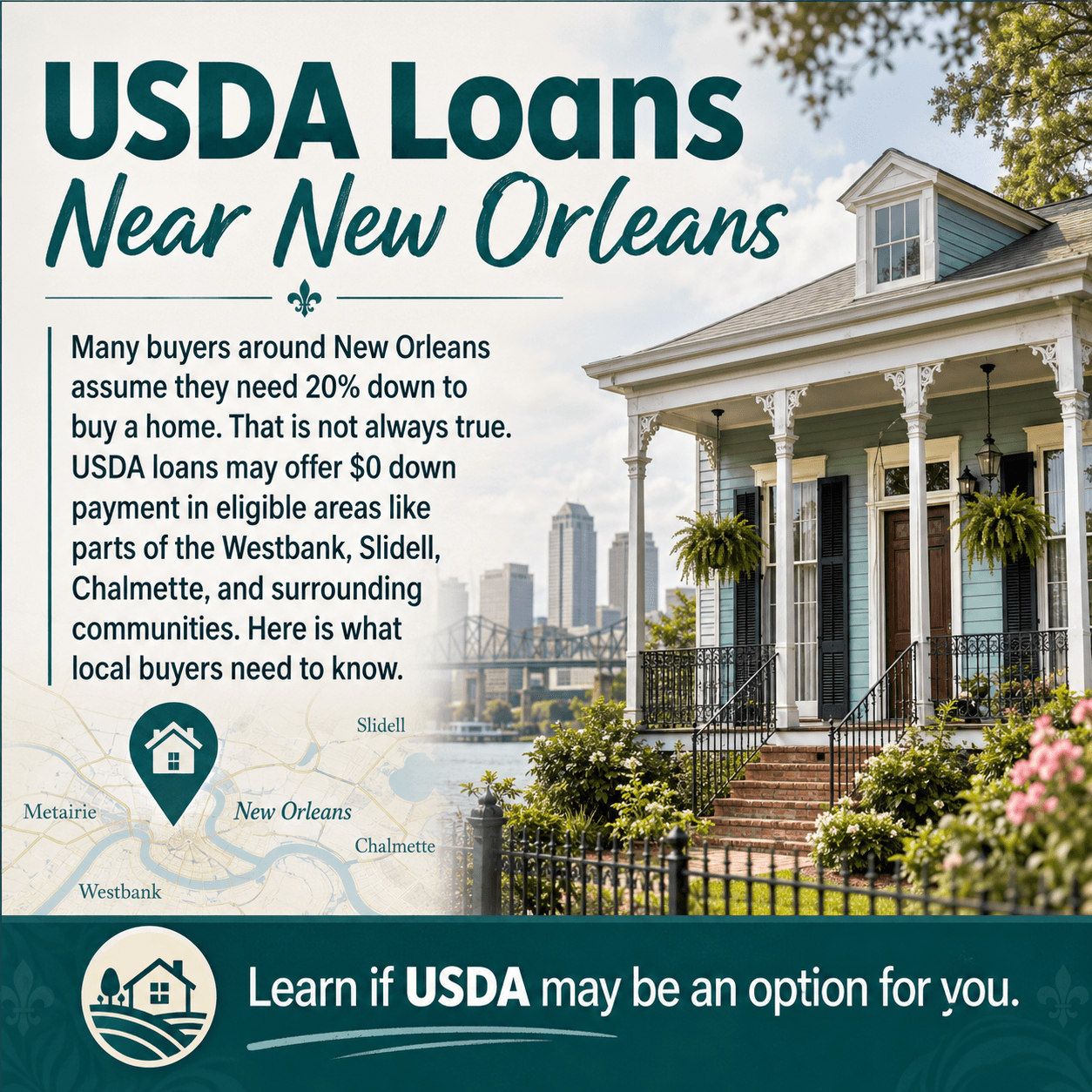
USDA Loans Near New Orleans: 2026 Eligibility, Income Limits, and Buyer Tips
One of the biggest misconceptions I hear from homebuyers is that they need 20% down to purchase a home.
That one belief keeps a lot of people from even starting the homebuying process.
The truth is, there are loan programs available that may allow qualified buyers to purchase with much less than 20% down. One of those programs is the USDA loan, which may offer eligible buyers a $0 down payment option when the home and borrower meet USDA guidelines.
For buyers in the New Orleans area, USDA can be a powerful option, but it is not available everywhere. That is why understanding property eligibility, income limits, debt-to-income requirements, insurance, flood zones, and credit requirements is so important before you start shopping.
At Max Mortgage, LLC, we help buyers compare options like USDA, FHA, VA, Conventional, and other loan programs so they can understand which path may fit their situation best.
What Is a USDA Loan?
A USDA loan is a mortgage program backed by the United States Department of Agriculture. Although many people think USDA loans are only for farms or remote rural properties, that is not always the case.
The USDA program is designed to support homeownership in eligible rural and suburban communities. In the New Orleans region, that can include certain areas outside the main metropolitan core.
The main advantage of USDA is the potential for $0 down payment for qualified buyers. That can reduce a buyer’s out-of-pocket cost by whatever down payment they may have needed with FHA or Conventional financing.
For many buyers, that difference can be significant.
Why USDA Loans Matter Around New Orleans
In Southeast Louisiana, affordability is not just about the sales price.
A buyer also has to consider homeowners insurance, flood insurance, property taxes, wind and hail coverage, and the overall monthly payment. These costs can vary significantly by parish, neighborhood, property type, and flood zone.
That is why USDA can be an important option for buyers who are open to eligible areas around the New Orleans region.
Local Insight: USDA eligibility is property-specific. A home is either in an eligible area or it is not. You cannot determine eligibility by guessing whether the neighborhood feels rural or suburban. The address must be checked.
Where USDA May Be a Possibility Near New Orleans
USDA is generally not available in the more metropolitan areas of New Orleans.
For example, if a buyer is shopping in areas like New Orleans, Harahan, Metairie, or Kenner, USDA is typically not going to be the option because those areas are considered metropolitan. In those cases, FHA may be the better low down payment option to review.
However, if a buyer is looking in USDA eligible areas such as parts of the Westbank, Slidell, Chalmette, or surrounding communities, then USDA may be a possibility.
Potential USDA search areas may include parts of:
- Westbank communities
- Slidell and surrounding St. Tammany areas
- Chalmette and parts of St. Bernard Parish
- Plaquemines Parish
- Tangipahoa Parish
- Livingston Parish
- Washington Parish
- Other outer communities surrounding the New Orleans metro
Again, eligibility is address-specific, so every property should be verified before assuming it qualifies.
What This Means for You in the New Orleans Area
If you are a homebuyer in the New Orleans area, the first question should not only be, “How much do I qualify for?”
A better question is:
“What loan program gives me the best overall path based on the property location, insurance costs, taxes, credit profile, and monthly payment?”
That is where USDA, FHA, VA, and Conventional comparisons become important.
USDA may help reduce upfront cash needed, but it also has stricter qualification rules than some other loan programs. FHA may be a better fit in metropolitan areas or for buyers who need more flexibility with debt-to-income ratios or credit profile.
This is why getting a second opinion mortgage loan comparison can be valuable before you commit to one loan path.
The Biggest USDA Advantage: $0 Down Payment
The main reason buyers ask about USDA is simple: the potential $0 down payment.
If a buyer qualifies for USDA and the property is eligible, that can reduce the borrower’s out-of-pocket cost compared to programs that require a down payment.
For example, with FHA, the minimum down payment is typically 3.5% for eligible borrowers. With Conventional financing, down payment requirements may vary based on the buyer’s profile and program.
With USDA, qualified buyers may be able to finance 100% of the purchase price.
That does not mean there are no costs at all. Buyers may still have closing costs, prepaid taxes, insurance, inspections, appraisal fees, and other expenses to consider.
But removing the down payment requirement can make homeownership more accessible for eligible buyers.
USDA Has Stricter Debt-to-Income Requirements
One of the biggest things buyers need to understand is that USDA can be more strict with debt-to-income ratios.
Debt-to-income ratio, often called DTI, compares your monthly debt payments to your qualifying income. USDA guidelines can be tighter than some other loan programs, which means a buyer may qualify for one program but not qualify for USDA.
This is especially important in Southeast Louisiana because insurance can have a major impact on the monthly payment.
When a homebuyer is interested in a house in a USDA eligible area, we review whether the property is in a flood zone. We also look to obtain homeowners insurance quotes and, if applicable, flood insurance quotes.
Once we know the insurance numbers, we can more accurately determine whether the homebuyer is still within the eligible USDA debt-to-income range for that specific property.
This is one reason I never recommend guessing the payment based only on the purchase price.
USDA Credit Score and GUS Underwriting
Another important point many buyers do not know is that USDA uses an underwriting system called GUS, which stands for Guaranteed Underwriting System.
GUS is USDA’s automated underwriting system, and it plays an important role in determining whether a file receives an eligible finding.
A key point buyers should know is that GUS requires a 640 minimum FICO credit score.
That does not mean credit score is the only thing that matters. Income, debts, assets, property eligibility, employment, and overall loan profile still matter. But the 640 score requirement is an important starting point for USDA financing.
This is one area where other lenders sometimes do not fully explain why USDA can be more stringent than other loan programs.
USDA Versus FHA Near New Orleans
USDA and FHA are both popular options for buyers who do not have 20% down.
But they are not the same.
USDA may be a great fit when:
- The property is in a USDA eligible area
- The household income fits USDA limits
- The buyer meets credit and underwriting requirements
- The debt-to-income ratio works
- Insurance and flood costs still keep the payment affordable
FHA may be a better fit when:
- The home is in a metropolitan area like New Orleans, Harahan, Metairie, or Kenner
- The buyer needs more flexibility with credit
- The debt-to-income ratio is too tight for USDA
- The property does not meet USDA location eligibility
- USDA income limits are an issue
The right answer depends on the buyer, the property, and the total monthly payment.
Can I Get a USDA Loan Near New Orleans?
Yes, it may be possible to get a USDA loan near New Orleans, but not in every area.
USDA eligibility depends on the property address and the borrower’s qualifications. A home in a metropolitan area may not qualify, while a home in a nearby eligible community may qualify.
That is why buyers should check eligibility early in the process.
What Areas Near New Orleans Are USDA Eligible?
USDA eligible areas may include certain communities outside the core New Orleans metro, such as parts of the Westbank, Slidell, Chalmette, St. Bernard Parish, St. Tammany Parish, Plaquemines Parish, Tangipahoa Parish, Livingston Parish, and other nearby areas.
However, eligibility can change by address, so the property must be verified.
Do USDA Loans Require a Down Payment?
USDA loans may offer $0 down payment for eligible buyers purchasing eligible properties.
This is one of the program’s biggest benefits. However, buyers still need to plan for closing costs, prepaid items, inspections, insurance, and other expenses.
Are USDA Loans Only for First-Time Homebuyers?
No. USDA loans are not limited only to first-time homebuyers.
Repeat buyers may also be eligible if they meet USDA guidelines, the property is eligible, and the overall loan profile qualifies.
Can I Use a USDA Loan in a Flood Zone?
A USDA loan may be possible on a property in a flood zone, but flood insurance must be reviewed.
In Southeast Louisiana, flood insurance can have a major impact on the total monthly payment. That monthly cost can also affect the buyer’s debt-to-income ratio.
Before moving forward on a USDA property, buyers should verify homeowners insurance and flood insurance as early as possible.
USDA Loan Myths Buyers Should Stop Believing
Myth: I need 20% down to buy a home.
Not always. Programs like USDA may offer $0 down payment for eligible buyers and eligible properties.
Myth: USDA loans are only for farms.
False. USDA loans can be used for eligible residential properties in qualifying rural or suburban areas.
Myth: If it is close to New Orleans, it will not qualify.
Not always. Some surrounding areas may be eligible, but the address must be checked.
Myth: USDA means I need no money at all.
False. USDA may offer $0 down payment, but closing costs, prepaid expenses, inspections, insurance, and other costs may still apply.
Myth: USDA is always better than FHA.
Not always. USDA can be excellent for the right buyer and property, but FHA may be better in metropolitan areas or when a buyer needs more underwriting flexibility.
Myth: Insurance does not affect qualification.
False. Insurance can directly affect the monthly payment and debt-to-income ratio.
A Practical USDA Buyer Checklist
Before shopping for a USDA eligible home near New Orleans, review these items:
- Is the property address USDA eligible?
- Is the buyer’s household income within USDA limits?
- Does the buyer meet USDA credit requirements?
- Does the file work through GUS?
- Is the credit score at least 640 for GUS eligibility?
- Does the debt-to-income ratio fit USDA guidelines?
- What are the homeowners insurance costs?
- Is flood insurance required?
- Are taxes, insurance, and total payment still affordable?
- Would FHA, VA, or Conventional be a better fit?
Your Action Plan
Step One: Get Pre-Qualified Before You Shop
Before falling in love with a home, find out what you may be eligible for.
You can call the 24/7 mortgage pre-qualification hotline at 504-399-4141 anytime to get pre-qualified and see what you may be eligible for.
Step Two: Compare USDA Against Other Loan Options
USDA may be a strong option, but it should not be reviewed in isolation.
At Max Mortgage, LLC, we offer second opinion mortgage loan comparisons so buyers can understand whether USDA, FHA, VA, Conventional, or another program may be the better fit.
Step Three: Check the Property Address
Do not assume a home is USDA eligible just because it is outside New Orleans.
The exact property address must be checked.
Step Four: Review Insurance Early
In Southeast Louisiana, insurance can make or break affordability.
Before moving too far into the process, review homeowners insurance and flood insurance so your monthly payment can be properly estimated.
Step Five: Start the Application
If you are ready to begin, you can complete the application online or call for help.
If you need someone to walk you through the entire mortgage application by phone, call the 24/7 mortgage loan application hotline at 504-332-0888.
Frequently Asked Questions
Is Jefferson Parish USDA eligible?
Some parts of Jefferson Parish may be too metropolitan for USDA eligibility, especially areas like Metairie, Kenner, and Harahan. Outer areas should be checked by exact address.
Can I use a USDA loan in Slidell?
Some areas in and around Slidell may be USDA eligible, depending on the specific property address. Buyers should verify eligibility before making an offer.
Can I use a USDA loan in Chalmette?
Chalmette and parts of St. Bernard Parish may be worth checking for USDA eligibility. The final answer depends on the exact property address and current USDA eligibility map.
Do USDA loans have income limits?
Yes. USDA loans have household income limits based on area and household size. This is one reason it is important to get properly pre-qualified.
Is USDA better than FHA?
Not always. USDA may offer $0 down payment, but FHA may offer more flexibility in certain situations. The better option depends on the buyer, property, credit profile, income, debt-to-income ratio, and location.
What credit score do I need for USDA?
USDA’s GUS underwriting system requires a 640 minimum FICO credit score. Other factors still matter, including income, debts, property eligibility, and overall loan profile.
What if I need help applying by phone?
You can call the 24/7 mortgage loan application hotline at 504-332-0888, and an agent can walk you through the mortgage application by phone.
Final Thoughts
USDA loans can be a valuable option for eligible buyers near the New Orleans area, especially because of the potential $0 down payment.
But USDA is not a one-size-fits-all loan.
The property must be eligible. The buyer must meet income and credit guidelines. The debt-to-income ratio must work. Insurance and flood costs must be reviewed. The file must also work through USDA’s underwriting requirements.
That is why it is important to work with someone who understands both the mortgage guidelines and the local realities of buying in Southeast Louisiana.
At Max Mortgage, LLC, we help buyers review their full picture so they can make a more informed decision before they shop, write an offer, or commit to one loan path.
Book a Consultation
Want to understand your real monthly payment before you shop?
Let's walk through insurance, flood risk, taxes, and financing options together.
📅 Schedule here: https://api.leadconnectorhq.com/widget/bookings/pre-qualcalendar
Start Your Application
Ready to begin?
📝 Apply here: https://1446745.my1003app.com/1413036/register
Have questions?
📱 Call us at 504-584-8999.
All loans subject to approval. Equal Housing Opportunity.