USDA Eligibility Near New Orleans in 2026: $0 Down Areas, Income Limits, and Local Buyer Tips
Can you use USDA $0 down financing near New Orleans? Learn where USDA may work, why New Orleans, Metairie, and Kenner are generally not eligible, and how income, flood zones, insurance, and parish selection affect approval.
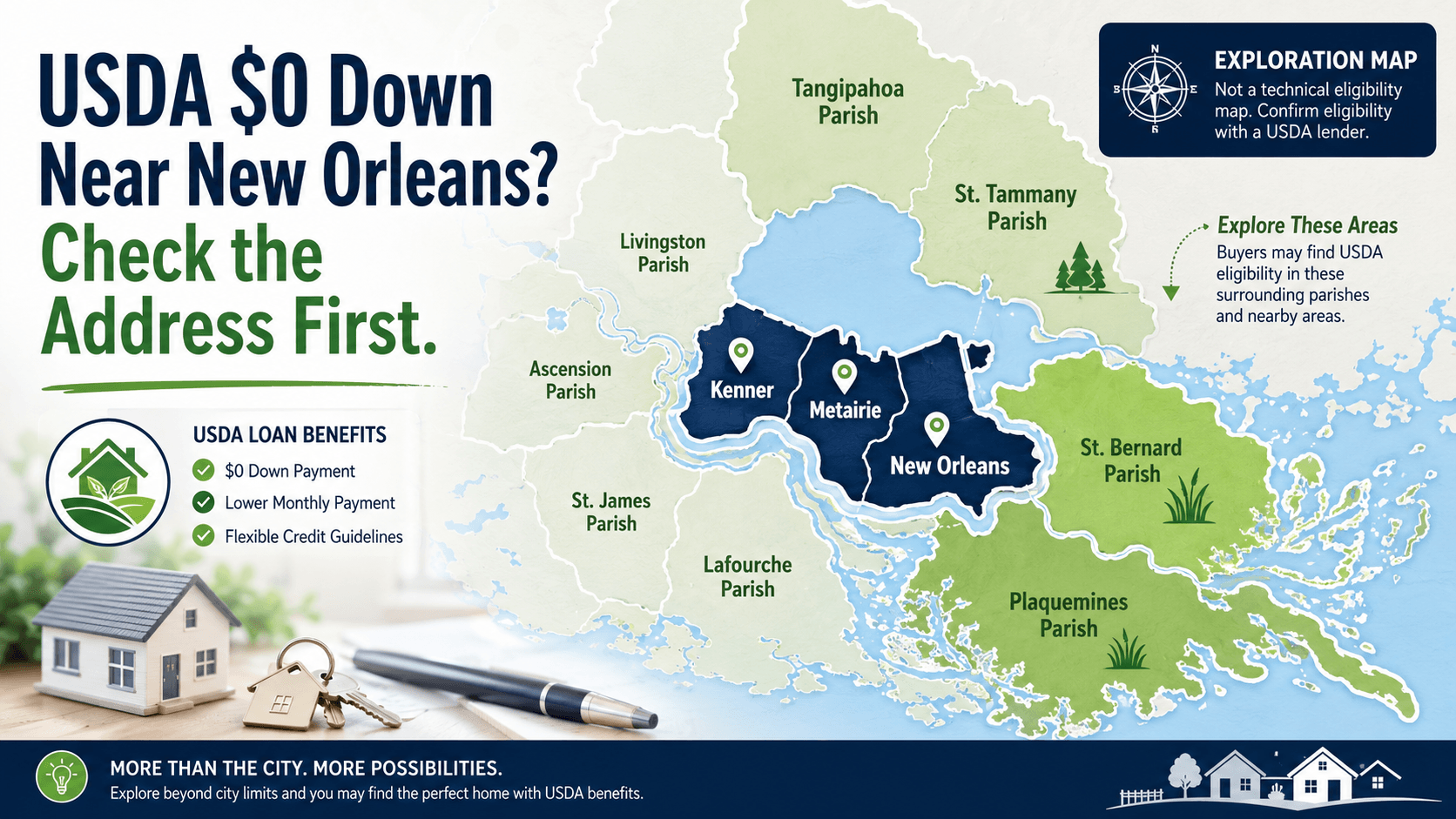
USDA $0 Down Near New Orleans: Where It Works, Where It Does Not, and What Buyers Need to Know
If you are trying to buy a home near New Orleans and want to keep more cash in your pocket, USDA financing may be one of the most misunderstood loan options available.
Many buyers hear “USDA loan” and think one of two things.
Either they think it is only for farms, or they think they can use it anywhere.
Neither is correct.
USDA financing is a rural and suburban-based loan product. That means it may be a powerful option in certain surrounding parishes, but it is generally not suited for metropolitan areas like New Orleans, Metairie, and Kenner.
I’m Charles H. Parharm, Jr., NMLS 1413036, with Max Mortgage, LLC. After more than 20 years in the mortgage and real estate industry, I have learned that the right loan program is not just about the down payment. It is about the buyer, the property, the income, the location, the insurance, the flood zone, the taxes, and the full monthly payment.
That is especially true with USDA.
What Is a USDA Loan?
A USDA loan is a government-backed mortgage program designed to help eligible buyers purchase a primary residence in qualifying rural or suburban areas.
For the right buyer and the right property, USDA may allow $0 down payment financing. That can be a major advantage for buyers who qualify and want to preserve cash for moving costs, inspections, reserves, insurance, or future home expenses.
USDA loans generally focus on:
- Primary residences
- Eligible rural or suburban property locations
- Household income limits
- Buyer credit, income, and repayment ability
- Property condition and livability standards
- Exact-address eligibility
The most important point is this: USDA is not just based on the buyer. The property must also qualify.
USDA Is Not for Every Area Near New Orleans
This is where many buyers get confused.
USDA is not designed for dense metropolitan areas. In our market, I explain to buyers that areas like New Orleans, Metairie, and Kenner are generally not USDA-eligible because they are part of the more urban metro footprint.
That does not mean USDA is unavailable near Southeast Louisiana.
It means buyers need to look at the right parishes and the right communities.
Depending on the exact address, buyers may need to explore areas outside the core metro, including parts of surrounding parishes that have a more rural or suburban character.
Areas buyers often ask about include:
- St. Tammany Parish
- Tangipahoa Parish
- St. Bernard Parish
- Plaquemines Parish
- Parts of the Northshore
- Hammond and Ponchatoula areas
- Slidell and surrounding communities
- Other eligible rural or suburban pockets outside the main metro area
The exact address always matters. A property can be close to an eligible area and still not qualify.
Local Insight From Charles
One of the biggest misunderstandings I see is buyers thinking USDA financing can be used anywhere, including in New Orleans. USDA is a great product for the right buyer, but it is not built for every location.
When I work with buyers, I explain that USDA is a rural and suburban loan product. If they want to use USDA, we need to look at eligible areas first, then make sure their income and the property both fit the program.
That small shift can save a buyer a lot of frustration.
Why USDA Matters in the New Orleans Area
In Southeast Louisiana, affordability is not just about the sales price.
Buyers also have to consider:
- Homeowners insurance
- Flood insurance
- Property taxes
- Parish-by-parish cost differences
- Flood-zone exposure
- Commute time
- Utility costs
- Cash needed after closing
- Property condition
This is why USDA can be valuable when it fits. If the program helps reduce the down payment requirement, the buyer may be able to keep more money available for other homeownership costs.
However, that advantage only works if the total payment still makes sense.
A lower down payment does not help much if flood insurance, homeowners insurance, or taxes push the payment beyond what the buyer can qualify for comfortably.
What This Means for You in the New Orleans Area
If you are shopping in the New Orleans region, do not start by assuming every home can work with USDA.
Instead, ask better questions:
- Is this property in a USDA-eligible area?
- Is the home rural or suburban enough to qualify?
- Does my household income fit USDA limits?
- Will the property condition meet USDA standards?
- Is the home in a flood zone?
- What will homeowners insurance and flood insurance cost?
- Does USDA give me a better structure than FHA?
- How much cash will I need to close?
That is the real strategy.
USDA can be excellent for one buyer and completely wrong for another. FHA may be better for some buyers, especially if they are shopping in metro areas or do not meet USDA income or property requirements.
USDA vs FHA Near New Orleans
I do not look at one factor when comparing USDA and FHA. I look at the whole picture.
Every client’s scenario is different. Some buyers may qualify for USDA because their income is within the limit and the property is in an eligible area. Other buyers may be better suited for FHA because of the property location, borrower profile, or overall qualification structure.
USDA may be a good fit when:
- The property is in a USDA-eligible rural or suburban area
- The buyer’s household income fits USDA limits
- The buyer wants to reduce down payment costs
- The home will be used as a primary residence
- The property meets USDA condition requirements
- Insurance and flood costs still support qualification
FHA may be a better fit when:
- The property is in New Orleans, Metairie, Kenner, or another non-USDA metro area
- The buyer does not meet USDA income limits
- The buyer needs more flexibility on location
- The property does not meet USDA eligibility rules
- FHA guidelines better match the buyer’s full profile
The goal is not to force a buyer into USDA or FHA. The goal is to compare the options and choose the loan structure that works best for the buyer’s actual situation.
A Real-World USDA Example
I recently worked with a couple who was able to qualify for USDA because two key pieces lined up.
Their income met the USDA requirements, and the property they were interested in was located in a USDA-eligible area.
That is exactly how this program should be evaluated. It is not enough for the buyer to qualify. It is not enough for the property to qualify. Both sides have to work together.
When they do, USDA can create a strong path to homeownership with less money required for the down payment.
Realtor Guidance: Show the Right Areas and Watch Flood Zones
For Realtors, USDA can be a very useful tool when working with payment-sensitive buyers, but the search strategy matters.
My advice is simple: if a buyer may qualify for USDA, show properties in USDA-eligible areas and pay close attention to flood zones.
Flood insurance can change the entire qualification picture. In some cases, flood insurance can push the monthly payment high enough that it affects the buyer’s ability to qualify for USDA.
That does not mean buyers should automatically avoid every property with flood insurance. It means the flood risk and insurance cost need to be reviewed early, not after the buyer has already fallen in love with the home.
Common USDA Myths Buyers Need to Stop Believing
Myth 1: USDA can be used anywhere
Not true. USDA is designed for eligible rural and suburban areas. Metropolitan areas like New Orleans, Metairie, and Kenner are generally not suited for USDA financing.
Myth 2: USDA is only for farms
Not true. USDA does not mean you have to buy a farm. Many USDA-eligible homes are in rural or suburban communities.
Myth 3: USDA is only for first-time buyers
USDA may be used by eligible buyers who meet the program requirements. It is not only for first-time buyers.
Myth 4: $0 down means no money needed at all
USDA may allow $0 down payment, but buyers may still have closing costs, prepaid taxes, insurance, inspections, appraisal costs, and other expenses.
Myth 5: If the parish has USDA areas, every home in that parish qualifies
Not true. USDA eligibility is based on the exact property address.
Myth 6: USDA is always better than FHA
Not always. USDA can be better for some buyers, while FHA may be better for others. The best option depends on the full client scenario.
People Also Ask: USDA Loans Near New Orleans
Can I use a USDA loan in New Orleans?
Generally, USDA is not suited for metropolitan areas like New Orleans. USDA is designed for eligible rural and suburban areas, so buyers usually need to look outside the dense urban core.
Can I use USDA in Metairie or Kenner?
Metairie and Kenner are generally considered part of the metro area and are typically not the type of locations USDA is designed for. Buyers should check exact-address eligibility before assuming a property qualifies.
How do I know if a house is eligible for USDA?
The exact property address must be checked using USDA eligibility guidelines. A city, parish, or neighborhood name is not enough.
What disqualifies a property from USDA?
A property may not qualify if it is outside an eligible area, does not meet condition standards, is not intended as a primary residence, or does not fit USDA property requirements.
What disqualifies a buyer from USDA?
A buyer may not qualify if household income exceeds the program limit, credit or debt-to-income factors do not meet requirements, or the overall file does not support repayment ability.
Is USDA better than FHA?
Sometimes. USDA may help reduce down payment needs if the buyer and property qualify. FHA may be better if the property is in a metro area or if the buyer’s scenario fits FHA guidelines more effectively.
Can flood insurance affect USDA qualification?
Yes. Flood insurance can increase the monthly payment and may affect the buyer’s ability to qualify. In Southeast Louisiana, this should be reviewed early.
Simple USDA Action Plan for New Orleans-Area Buyers
Step 1: Get pre-qualified before shopping
Do not start with the house first. Start with your numbers.
Step 2: Identify whether USDA is realistic for your target area
If you want to live in New Orleans, Metairie, or Kenner, USDA may not be the right loan program. If you are open to rural or suburban areas in surrounding parishes, USDA may be worth exploring.
Step 3: Check exact-address eligibility
Before getting too attached to a home, check whether the exact property address is USDA-eligible.
Step 4: Review household income limits
USDA has income limits. Your household size and income matter.
Step 5: Compare USDA and FHA side by side
Look at down payment, monthly payment, mortgage insurance, insurance costs, taxes, and cash to close.
Step 6: Review flood zone and insurance costs
This is critical in Southeast Louisiana. Flood insurance can change the payment and qualification.
Step 7: Make the offer with the right strategy
If USDA fits, your offer strategy should account for closing costs, seller concessions, inspections, timelines, and property condition.
FAQ: USDA $0 Down Near New Orleans
Is USDA available in Orleans Parish?
USDA is generally not designed for dense metro areas like New Orleans. Some surrounding areas may be worth checking, but exact-address eligibility is required.
What areas near New Orleans may qualify for USDA?
Some rural and suburban areas in surrounding parishes may qualify. Buyers often explore parts of St. Tammany, Tangipahoa, St. Bernard, Plaquemines, and other nearby communities.
Can I use USDA if I already own a home?
Possibly, depending on your full situation and program requirements. USDA is for primary residences, and eligibility must be reviewed carefully.
Does USDA require flood insurance?
If the property is located in a flood zone where flood insurance is required, that cost must be included in the payment analysis.
Why does flood insurance matter so much for USDA?
Because it can increase the monthly payment. If the payment gets too high, it may affect qualification.
Can a Realtor help me find USDA-eligible homes?
Yes. Realtors can help by showing properties in USDA-eligible areas, but the mortgage side should verify exact-address eligibility and affordability before the buyer moves too far forward.
Should I choose USDA or FHA?
That depends on your income, credit profile, target area, property address, cash to close, insurance costs, and overall qualification. The best approach is to compare both options.
Final Thoughts
USDA $0 down financing can be a powerful option for the right buyer in the right location, but it is not a one-size-fits-all loan.
It is not designed for every area. It is not typically suited for metro locations like New Orleans, Metairie, and Kenner. It works best when the buyer qualifies, the property qualifies, and the full payment still makes sense.
For buyers, that means you need more than a quick answer. You need a local strategy.
For Realtors, it means guiding buyers toward USDA-eligible areas when appropriate and watching flood zones carefully because flood insurance can affect the borrower’s qualification.
Book a Consultation
Want to understand your real monthly payment before you shop?
Let's walk through insurance, flood risk, taxes, and financing options together.
📅 Schedule here: https://api.leadconnectorhq.com/widget/bookings/pre-qualcalendar
Start Your Application
Ready to begin?
📝 Apply here: https://1446745.my1003app.com/1413036/register
Have questions?
📱 Call us at 504-584-8999.
All loans subject to approval. Equal Housing Opportunity.