New Orleans FHA Down Payment Assistance in 2026: Grant Money, Forgivable DPA, Repayable DPA, and Seller Credits Explained
Learn how FHA down payment assistance works in New Orleans and surrounding parishes, including grant myths, wholesale lender DPA programs, forgivable vs. repayable assistance, seller credits, insurance, and cash-to-close strategy.
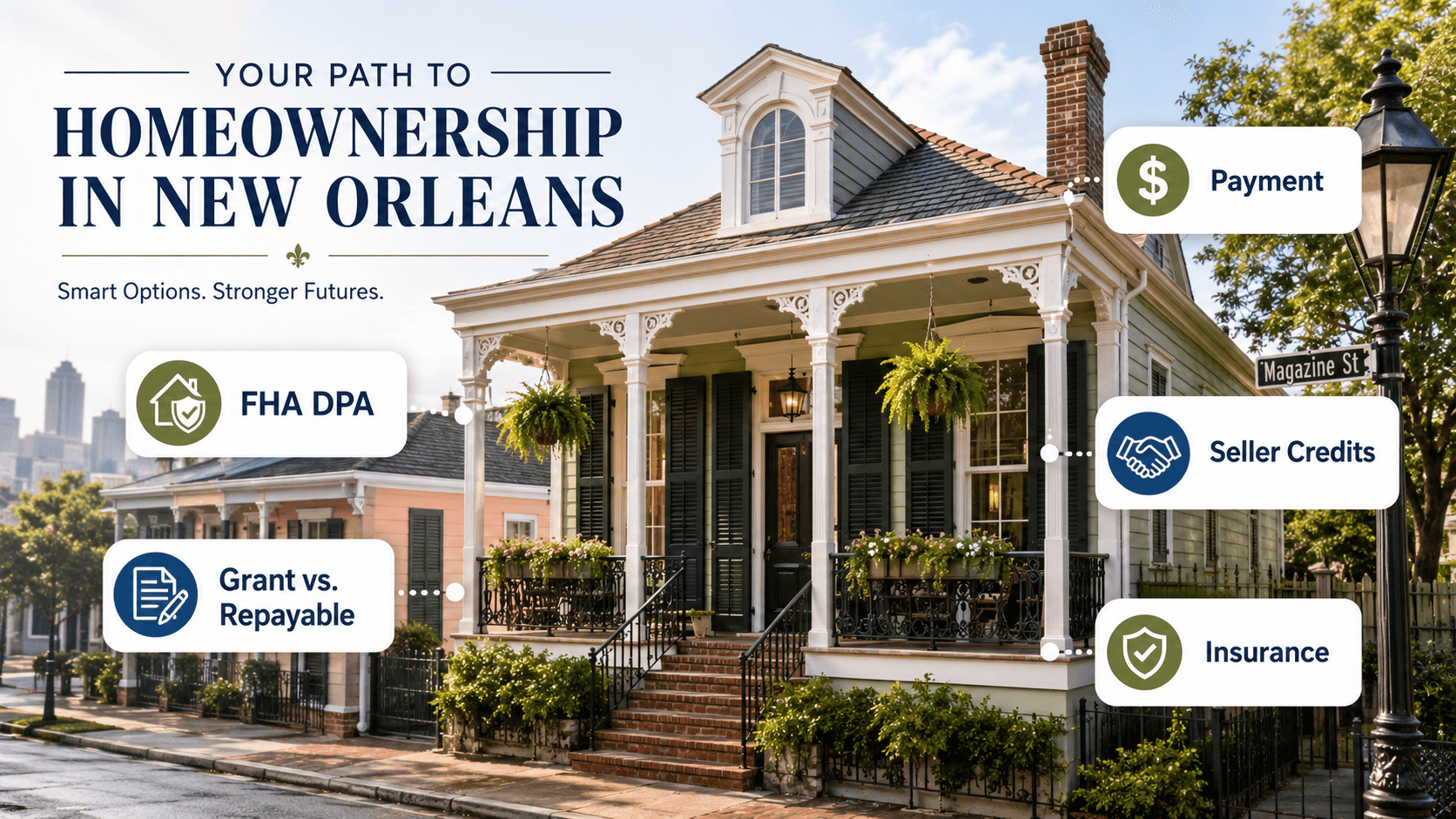
New Orleans FHA Down Payment Assistance in 2026: What Buyers Must Know Before They Shop
Many homebuyers in the New Orleans area hear the words “down payment assistance” and immediately think one thing: grant money.
That is one of the biggest misunderstandings I see.
Down payment assistance can include grants, but that is not the only option. Some FHA DPA programs are offered through housing agencies, some are forgivable second mortgages, some are repayable second mortgages, and some wholesale lenders offer their own FHA down payment assistance programs that do not require the same special qualifying rules as many grant programs.
That difference matters.
I’m Charles H. Parharm, Jr. with Max Mortgage, LLC. I have spent more than 20 years helping buyers, homeowners, and Realtor partners understand mortgage options in New Orleans and the surrounding parishes. With FHA down payment assistance, the question is not just, “Can I get help with the down payment?”
The better question is:
Which FHA DPA option gives me the best overall payment, approval strength, and long-term strategy?
The Biggest Misunderstanding About FHA Down Payment Assistance
The most common misunderstanding I hear from buyers, not only in the New Orleans area but everywhere, is that they believe down payment assistance only means grant money.
That is not true.
There are multiple types of FHA DPA structures, and they do not all work the same way.
Some may be:
- Grant-style assistance
- Forgivable second mortgages
- Repayable second mortgages
- Deferred second mortgages
- Lender-provided FHA DPA options
- State, city, or parish-based assistance programs
Some programs have income limits, homebuyer education requirements, property restrictions, purchase price caps, or special qualifying rules.
Other FHA DPA programs, including some wholesale lender programs, may not require the same type of special qualifying as many grant programs.
That is why it is important to review the full structure before assuming whether you qualify or whether the program is the right fit.
Why FHA DPA Matters in New Orleans and Surrounding Parishes
In the New Orleans area, buyers are dealing with more than just the sales price.
A smart mortgage conversation needs to include:
- Down payment
- Closing costs
- Homeowners insurance
- Flood insurance, if required
- Property taxes
- Parish-specific costs
- Seller concessions
- Monthly mortgage insurance
- Interest rate
- Debt-to-income ratio
- Cash needed to close
This is especially important in areas like Orleans Parish, Jefferson Parish, St. Bernard Parish, St. Tammany Parish, Plaquemines Parish, and surrounding communities where property taxes, insurance, flood zones, and home prices can vary widely.
A buyer shopping in Algiers, Gentilly, New Orleans East, Kenner, Marrero, Chalmette, Slidell, Mandeville, or Belle Chasse may have different affordability factors even if the loan program is the same.
Local Insight: The Payment Comes First
When I review FHA down payment assistance with a buyer, the first thing I want them to understand is the payment.
Not the headline assistance amount.
Not just the down payment.
The payment.
There are two common types of FHA DPA structures buyers need to understand:
Forgivable FHA DPA
Forgivable DPA means the buyer may have to live in the property for a specific period of time. If the buyer meets the program requirements, the assistance may be forgiven.
However, the interest rate on forgivable DPA can be higher than a repayable DPA option.
That matters because a higher rate can increase the monthly payment and may affect the buyer’s debt-to-income ratio.
Repayable FHA DPA
Repayable DPA is exactly what it sounds like. The assistance is usually structured as a second mortgage and is paid back over a specified period of time.
In some cases, the rate on the first mortgage may be lower than a forgivable DPA option, but the buyer has an additional payment on the second mortgage.
This is why the payment comparison matters so much.
A buyer should not choose a program only because it reduces upfront cash. The right question is whether the full payment works and whether the buyer can still qualify comfortably.
What This Means for You in the New Orleans Area
If you are buying in the New Orleans area, FHA DPA may help reduce the upfront cash needed to buy a home. But it may also change the interest rate, monthly payment, or debt ratio.
That is why buyers and Realtor partners need to look at the full picture early.
A buyer may qualify for a regular FHA loan, but when a DPA option is added, the rate or second mortgage payment may push the buyer’s debt ratio too high.
That does not mean DPA is bad.
It means DPA must be structured correctly.
For some buyers, a forgivable DPA program may make sense. For others, a repayable DPA may be better. For some, seller concessions may be more powerful than DPA. For others, combining FHA financing, DPA, and seller credits may create the best outcome.
The key is strategy.
FHA DPA Is Great, But It Can Come at a Cost
This is something I want Realtor partners to understand clearly.
DPA programs are great, but they can come at a cost.
Sometimes, because the interest rate is higher on an FHA loan with DPA, it can push the homebuyer out of qualifying because the debt ratios become too high.
That is why it is important to review the buyer’s approval before showing homes and before writing the offer.
A Realtor may see a buyer who has “down payment assistance” and assume the buyer has solved the cash-to-close issue. But if the DPA structure increases the payment too much, the buyer may need to adjust the price range, seller credit strategy, or loan structure.
This is where the lender and Realtor need to work together before the buyer gets emotionally attached to a property.
Can You Use FHA With Down Payment Assistance in Louisiana?
Yes, in many cases FHA financing can be paired with approved down payment assistance options.
But the rules depend on the assistance source.
Some programs are tied to state or local housing agencies. Some are tied to specific cities or parishes. Some may be offered by wholesale lenders. Some may require a first-time buyer status, while others may not have the same type of requirements.
Before choosing a program, buyers should ask:
- Is this assistance grant-style, forgivable, repayable, or deferred?
- Does it increase the interest rate?
- Is there a second mortgage payment?
- Does it have to be repaid if I sell or refinance?
- How long do I have to live in the home?
- Does it have income limits?
- Does the property have to be in a certain parish or city?
- Will this help or hurt my debt-to-income ratio?
Does FHA DPA Cover Closing Costs Too?
Sometimes it can, depending on the program.
But buyers need to understand that the down payment and closing costs are not the same thing.
Even with down payment assistance, a buyer may still need money for:
- Earnest money deposit
- Home inspection
- Appraisal
- Prepaid homeowners insurance
- Prepaid flood insurance, if required
- Property tax escrows
- Other settlement charges
- Reserves, if required
This is especially important in Louisiana, where homeowners insurance and flood insurance can have a major impact on both cash to close and monthly payment.
Seller Credits Can Be a Major FHA Strategy
One of the most underused strategies for FHA buyers is seller concessions.
With FHA financing, whether DPA is being used or not, the seller can pay up to 6% of the sales price toward the borrower’s allowable closing costs and prepaid expenses.
That can be powerful.
I have seen situations where there were enough seller concessions left over after the seller paid the buyer’s closing costs that we were able to use the excess funds to buy the interest rate down for the borrower.
That can make the payment more affordable for the homebuyer.
For example, if a buyer is using FHA financing and the seller agrees to help with closing costs, those funds may reduce the buyer’s cash to close. If there is still room within FHA guidelines and the transaction allows it, some of those funds may be used toward a rate buydown.
That could be the difference between a payment that feels tight and a payment that works.
Myth-Busting FHA DPA in New Orleans
Myth 1: Down payment assistance is always grant money
Not true. DPA can be grant-style, forgivable, repayable, deferred, or lender-provided. Buyers need to know what type they are using.
Myth 2: The most assistance is always the best option
Not always. A program with more assistance may have a higher rate or payment. The best option is the one that fits the buyer’s cash-to-close needs and monthly payment.
Myth 3: DPA means the buyer does not need any money
Not always. Buyers may still need funds for inspections, appraisal, earnest money, prepaid insurance, flood insurance, and reserves.
Myth 4: FHA DPA automatically makes approval easier
Not necessarily. If the DPA comes with a higher rate or second mortgage payment, it may affect debt ratios.
Myth 5: Seller credits are not as important if the buyer has DPA
Seller credits can still be extremely valuable. In some cases, they may help reduce cash to close or support an interest rate buydown.
People Also Ask: FHA DPA Questions Buyers Are Searching
Is FHA down payment assistance only for first-time buyers?
Not always. Many programs are designed for first-time buyers, but not every FHA DPA option has the same first-time buyer rules. Some lender-based programs may have different requirements.
Is FHA DPA free money?
Sometimes, but not always. Some assistance may be forgiven over time, while other assistance may need to be repaid as a second mortgage.
Does FHA DPA increase my interest rate?
It can. Some DPA programs may come with a higher interest rate than a standard FHA loan or a repayable assistance option.
Can seller concessions be used with FHA DPA?
In many cases, yes, as long as everything is structured within FHA and program guidelines. FHA allows seller concessions up to 6% of the sales price for allowable costs.
Can DPA hurt my approval?
It can if the payment increases too much or if the second mortgage payment pushes the buyer’s debt-to-income ratio too high.
Should I use DPA or seller credits?
It depends on your full loan structure, cash-to-close needs, monthly payment, and seller negotiation opportunity.
Action Plan for FHA DPA Buyers in New Orleans
Step 1: Start with the monthly payment
Do not only ask how much assistance you can receive. Ask what the final payment looks like.
Step 2: Compare DPA types
Review whether the program is forgivable, repayable, deferred, grant-style, or lender-provided.
Step 3: Review insurance early
In New Orleans and surrounding parishes, insurance can change the approval picture quickly.
Step 4: Know your parish and property type
Orleans Parish, Jefferson Parish, St. Bernard, St. Tammany, and other surrounding areas may have different program options and cost factors.
Step 5: Build seller concessions into the offer strategy
If the market allows, seller concessions may help with closing costs or possibly a rate buydown.
Step 6: Get fully reviewed before shopping
A strong pre-approval should include loan type, payment, DPA structure, insurance assumptions, and cash-to-close estimate.
FAQ: FHA Down Payment Assistance in New Orleans and Surrounding Parishes
1. Is FHA DPA always a grant?
No. FHA DPA can be grant-style, forgivable, repayable, deferred, or offered through certain lender programs.
2. What is the difference between forgivable and repayable DPA?
Forgivable DPA may be forgiven after the buyer meets occupancy and time requirements. Repayable DPA is usually a second mortgage that is paid back over time.
3. Can FHA DPA increase my monthly payment?
Yes. Some DPA programs may have a higher interest rate or a second mortgage payment, which can affect the monthly payment.
4. Can seller credits help FHA buyers in Louisiana?
Yes. FHA allows sellers to contribute up to 6% of the sales price toward allowable closing costs and prepaid expenses.
5. Can seller concessions be used to buy down the interest rate?
In some cases, yes. If there are enough allowable seller concessions after covering closing costs and prepaid items, funds may be used toward an eligible rate buydown.
6. Is DPA always the best choice?
Not always. The best option depends on the buyer’s cash to close, monthly payment, debt ratio, long-term plans, and available seller concessions.
7. Should Realtors ask about the buyer’s DPA structure before showing homes?
Yes. Realtor partners should understand whether the buyer’s DPA affects the rate, payment, price range, and approval strength.
Final Thoughts
FHA down payment assistance can be a tremendous tool for buyers in New Orleans and the surrounding parishes, but it needs to be understood correctly.
It is not always grant money.
It is not always free.
It is not always the lowest payment option.
And it is not always the best fit just because it lowers the upfront cash needed.
The right FHA DPA strategy compares the full picture: payment, cash to close, interest rate, insurance, flood risk, seller concessions, and long-term affordability.
That is how buyers make confident decisions, and that is how Realtor partners help protect the transaction before problems show up late in the process.
Book a Consultation
Want to understand your real monthly payment before you shop?
Let's walk through insurance, flood risk, taxes, and financing options together.
📅 Schedule here: https://api.leadconnectorhq.com/widget/bookings/pre-qualcalendar
Start Your Application
Ready to begin?
📝 Apply here: https://1446745.my1003app.com/1413036/register
Have questions?
📱 Call us at 504-584-8999.
All loans subject to approval. Equal Housing Opportunity.