New Orleans DSCR Loans: Can Sellers Pay 6% Toward Closing Costs?
Learn how 6% seller concessions may help New Orleans real estate investors cover DSCR loan closing costs, why insurance and taxes matter, and how to structure your offer wisely.
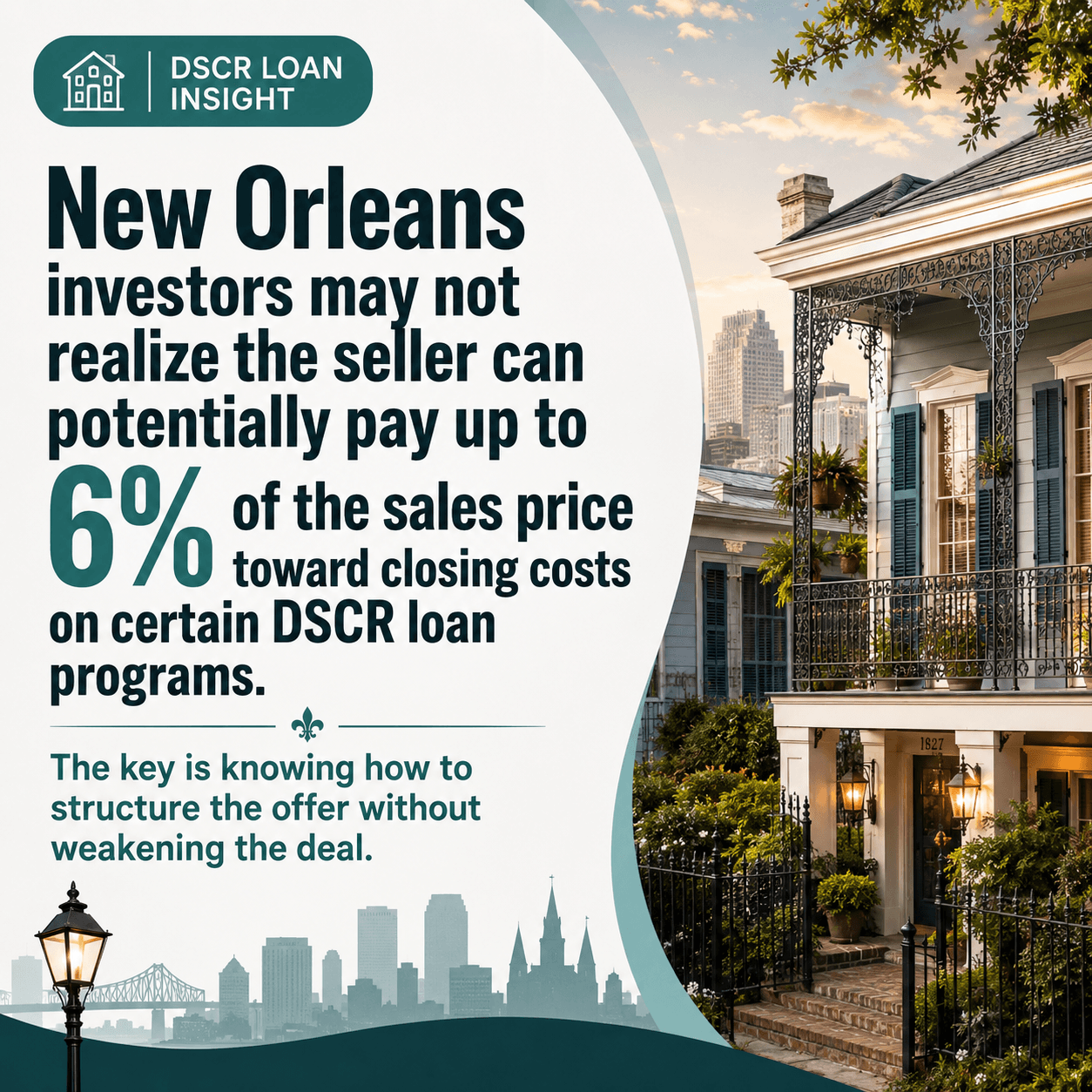
New Orleans DSCR Loans: Can Sellers Pay 6% Toward Investor Closing Costs?
Many real estate investors in the New Orleans area are not aware of one powerful DSCR loan strategy:
On certain DSCR loan programs, the seller may be able to pay up to 6% of the sales price toward the investor’s closing costs.
That can be a big deal for buyers purchasing rental property in Orleans Parish, Jefferson Parish, St. Tammany Parish, St. Bernard Parish, Plaquemines Parish, and other surrounding areas.
But here is the important part: just because a seller may be allowed to contribute up to 6% does not mean the offer should be structured casually.
I am Charles H. Parharm, Jr., NMLS 1413036, with Max Mortgage, LLC. After more than 20 years in the mortgage and real estate industry, I have learned that investor financing is not just about finding a loan. It is about understanding the numbers before the offer is written.
With DSCR loans, those numbers include purchase price, estimated rent, mortgage payment, insurance, property taxes, reserves, closing costs, and the seller concession strategy.
What Is a DSCR Loan?
A DSCR loan, or Debt Service Coverage Ratio loan, is a mortgage option commonly used by real estate investors.
Instead of qualifying primarily through traditional personal income documentation, the lender focuses heavily on the income potential of the property.
In simple terms, the lender wants to know:
Does the rental income support the mortgage payment?
That monthly payment may include principal, interest, taxes, insurance, and association dues when applicable.
This can make DSCR financing attractive for investors who have strong rental properties but may have complicated tax returns, business write-offs, multiple income streams, or nontraditional income.
The Big Opportunity: 6% Seller Concessions on Certain DSCR Loans
One of the biggest opportunities many investors miss is that certain DSCR loan programs may allow the seller to contribute up to 6% of the sales price toward the buyer’s closing costs.
That seller credit may potentially help cover allowable costs such as:
- Lender fees
- Title fees
- Settlement fees
- Prepaid homeowners insurance
- Prepaid property taxes
- Escrow setup
- Flood insurance prepaids, if applicable
- Discount points, if allowed by the program
- Other allowable closing costs
This can help investors preserve more cash after closing, which is especially important in the New Orleans market where insurance and taxes can create surprises.
Local Insight: Insurance and Taxes Can Change the Deal
In the New Orleans area, the two numbers that most often surprise investors are:
Homeowners insurance and property taxes.
That is why I always advise investors to get insurance quotes while they are deciding which properties they want to purchase. Do not wait until you are deep into the loan process to find out the insurance premium is much higher than expected.
A rental property in Orleans Parish may have a different insurance and tax profile than a property in Metairie, Kenner, Gretna, Marrero, Slidell, Mandeville, Covington, Chalmette, or Belle Chasse.
Local factors that can affect the numbers include:
- Homeowners insurance
- Flood insurance
- Wind and hail coverage
- Property taxes by parish
- Roof age
- Property condition
- Flood zone
- Rental income potential
- HOA or condo dues
- Required reserves
A seller concession may help reduce cash needed at closing, but it does not erase the need for the property to qualify based on the lender’s DSCR calculation.
The Number I Look at After the Purchase Price
After reviewing the purchase price, one of the next numbers I look at is the credit ratio, also commonly understood as the DSCR ratio.
In practical terms, the estimated rental income should exceed the estimated mortgage payment by 25% or more.
That means the rental income should generally be strong enough to show that the property has breathing room after the estimated mortgage payment is considered.
If that ratio is less than 25%, it can dramatically affect the loan parameters. Depending on the lender and program, that may mean:
- A larger down payment may be required
- The interest rate could be higher
- The loan terms may become less favorable
- The deal may need to be restructured
- The investor may need stronger reserves
- The property may not fit the desired loan program
This is why we do not just look at whether the seller can pay closing costs. We look at whether the overall deal works.
What This Means for You in the New Orleans Area
If you are buying an investment property in the New Orleans metro area, the 6% seller concession strategy can be valuable, but it must be used correctly.
Here is a simple example.
Let’s say an investor is buying a rental property for $300,000. A 6% seller concession could potentially equal up to $18,000 toward allowable closing costs and prepaid items, depending on the loan program and lender guidelines.
That sounds great, but the deal still has to make sense.
If the homeowners insurance is higher than expected, the property taxes are higher than projected, or the estimated rent is not strong enough, the seller concession alone will not fix the DSCR ratio.
Now consider another investor purchasing a property where the projected rent is strong, the insurance quote is reasonable, and the property taxes are manageable. In that situation, a seller concession may help the investor preserve cash, reduce out-of-pocket closing costs, and keep more reserves after closing.
That is the type of strategy that can make a real difference.
People Also Ask: Can a Seller Pay Closing Costs on a DSCR Loan?
Yes, on certain DSCR loan programs, the seller may be able to contribute toward the investor’s allowable closing costs.
The exact amount depends on the lender, loan program, property type, loan-to-value, credit profile, and overall file structure.
People Also Ask: Can the Seller Pay Up to 6% on a DSCR Loan?
Certain DSCR programs may allow seller concessions up to 6% of the sales price. However, this is not automatic across every lender or every DSCR loan program.
This is why investors should confirm the seller concession limit before writing the offer.
People Also Ask: What Can a 6% Seller Concession Be Used For?
A seller concession may be used toward allowable closing costs and prepaids. This may include title fees, lender costs, prepaid insurance, property taxes, escrow setup, and other eligible settlement charges.
Whether it can be used for discount points or rate structure depends on the lender’s guidelines.
People Also Ask: Does a 6% Seller Concession Lower My Down Payment?
Usually, seller concessions help with allowable closing costs and prepaid items. They typically do not replace the required down payment.
Investors should still be prepared for the down payment, reserves, and any costs not covered by the seller credit.
People Also Ask: Do DSCR Loans Require Personal Income?
DSCR loans are generally designed around the property’s rental income potential instead of traditional personal income documentation.
However, lenders still review credit, assets, reserves, appraisal, rent schedule, insurance, and the full risk profile of the file.
People Also Ask: How Does Insurance Affect DSCR Approval in Louisiana?
Insurance can have a major impact on DSCR approval because it affects the total mortgage payment. In Louisiana, homeowners insurance, flood insurance, and wind coverage can materially change the monthly number.
That is why investors should get insurance quotes early, especially before making a final decision on which property to pursue.
Myth-Busting: DSCR Seller Concession Misunderstandings
Myth 1: Investors always have to pay all closing costs themselves.
Not always. On certain DSCR programs, the seller may be able to pay up to 6% of the sales price toward allowable closing costs.
Myth 2: A 6% seller concession means the deal automatically works.
Not true. The property still needs to meet the lender’s DSCR requirements.
Myth 3: Seller concessions fix weak rental income.
No. Seller concessions may help cash to close, but they do not change whether the rental income supports the mortgage payment.
Myth 4: Insurance can be checked later.
That is risky in the New Orleans area. Insurance should be reviewed early because it can affect both monthly payment and qualifying.
Myth 5: If you ask for 6%, you can still write a lowball offer.
This is one of the biggest mistakes investors can make. If you want the seller to pay 6% of the sales price toward your closing costs, do not write a lowball offer.
Asking for a large seller concession is part of the negotiation. If the offer price is too low and you also ask for a large seller credit, the seller may not take the offer seriously.
Offer Strategy: Do Not Lowball the Seller If You Want 6%
This point deserves its own section.
If you are going to ask the seller to pay up to 6% of the sales price toward your closing costs, your offer has to be structured strategically.
A seller concession reduces the seller’s net proceeds. So if you combine a low offer price with a large seller concession request, the seller may view the offer as too weak.
A stronger strategy may include:
- Understanding the seller’s motivation
- Reviewing days on market
- Looking at comparable sales
- Knowing the property’s condition
- Confirming rental income potential
- Getting insurance quotes early
- Structuring the offer with the seller’s net in mind
- Making sure the financing terms are realistic
The goal is not just to ask for 6%. The goal is to create an offer that has a chance of being accepted and still works for the investor.
Questions to Ask Before You Write the Offer
Before asking for seller concessions on a DSCR purchase, ask these questions:
- Does this DSCR program allow up to 6% seller concessions?
- What costs can the seller concession cover?
- Can the concession be used toward points, or only closing costs and prepaids?
- What is the estimated rental income?
- Does the rental income exceed the estimated mortgage payment by 25% or more?
- What is the estimated homeowners insurance premium?
- Is flood insurance required?
- What are the estimated property taxes?
- Are reserves required?
- Will the property qualify if it is used as a short-term rental?
- Does the offer still make sense from the seller’s perspective?
Action Plan for New Orleans Area Investors
Here is the simple plan I recommend:
Step 1: Get pre-qualified before shopping.
Know your estimated budget, down payment, cash-to-close range, and lender options before making an offer.
Step 2: Review the rent potential.
Do not rely only on the listing description. Make sure the estimated rental income supports the loan strategy.
Step 3: Check the DSCR ratio early.
The estimated rental income should ideally exceed the estimated mortgage payment by 25% or more.
Step 4: Get insurance quotes before you commit.
In New Orleans and surrounding parishes, homeowners insurance and flood insurance can change the numbers quickly.
Step 5: Confirm the seller concession limit.
Do not assume every lender allows 6%. Confirm the program before writing the offer.
Step 6: Do not lowball the seller if asking for 6%.
If you want a large seller concession, structure the offer with the seller’s net proceeds in mind.
Step 7: Get a second opinion.
At Max Mortgage, we offer second opinion mortgage loan comparisons. If you already received a DSCR quote, we can review it with you so you understand the structure, costs, cash-to-close, seller concession options, and overall loan terms.
FAQ: New Orleans DSCR Loans and 6% Seller Concessions
Can I use a DSCR loan to buy a rental property in New Orleans?
Yes, DSCR loans may be available for qualifying investment properties in New Orleans and surrounding parishes. Approval depends on the property, rental income, credit profile, down payment, reserves, and lender guidelines.
Can a seller pay up to 6% of my closing costs on a DSCR loan?
Certain DSCR loan programs may allow the seller to contribute up to 6% of the sales price toward allowable closing costs. This must be confirmed with the specific lender and loan program.
Can seller concessions cover my down payment?
Seller concessions generally help with allowable closing costs and prepaid items. They typically do not replace the required down payment.
Why do insurance and taxes matter so much on DSCR loans?
Insurance and taxes are part of the overall payment calculation. If they are higher than expected, they can weaken the DSCR ratio and affect the loan terms.
What DSCR ratio do investors need?
Requirements vary by lender, but a strong target is for the estimated rental income to exceed the estimated mortgage payment by 25% or more.
Should I ask for 6% seller concessions on every DSCR offer?
Not necessarily. The seller concession strategy should be based on the property, the seller’s motivation, market conditions, the investor’s cash-to-close needs, and the strength of the offer.
Can I get a second opinion on a DSCR loan quote?
Yes. Max Mortgage offers second opinion mortgage loan comparisons so investors can better understand the loan structure, costs, seller concession options, and potential deal concerns before moving forward.
Final Thoughts
DSCR seller concessions can be a smart tool for New Orleans area investors, especially when the seller may be able to pay up to 6% of the sales price toward allowable closing costs.
But the strategy has to be handled correctly.
The seller concession does not replace sound deal analysis. You still need to review rental income, homeowners insurance, property taxes, flood insurance, reserves, and the DSCR ratio.
And if you are asking for 6% from the seller, remember this important advice:
Do not write a lowball offer.
A strong investor offer is not just about price. It is about structure, timing, cash-to-close, seller net proceeds, and whether the loan strategy truly supports the property.
If you are considering a rental property in New Orleans or the surrounding parishes, let’s review the numbers before you write the offer.
Book a Consultation
Want to understand your real monthly payment before you shop?
Let's walk through insurance, flood risk, taxes, and financing options together.
📅 Schedule here: https://api.leadconnectorhq.com/widget/bookings/pre-qualcalendar
Start Your Application
Ready to begin?
📝 Apply here: https://1446745.my1003app.com/1413036/register
Have questions?
📱 Call us at 504-584-8999.
Need a Fast Pre-Qualification?
We have incorporated our 24/7 mortgage pre-qualification hotline. Anyone can call at any time to get pre-qualified and see what they may be eligible for.
Simply call our 24/7 hotline at 504-399-4141.
Need Help Completing the Application?
We also have our 24/7 mortgage loan application hotline. Anyone at any time can call, and our agent will walk them through the entire application over the phone. This is especially helpful for anyone who needs assistance completing an application.
Simply call our 24/7 hotline at 504-332-0888.
All loans subject to approval. Equal Housing Opportunity.