DSCR vs Conventional Investment Loans in New Orleans: Which Is Better for Rental Properties?
Comparing DSCR and conventional investment loans in New Orleans and surrounding parishes. Learn qualification rules, prepayment penalties, reserves, and which strategy works best for long-term rental investors.
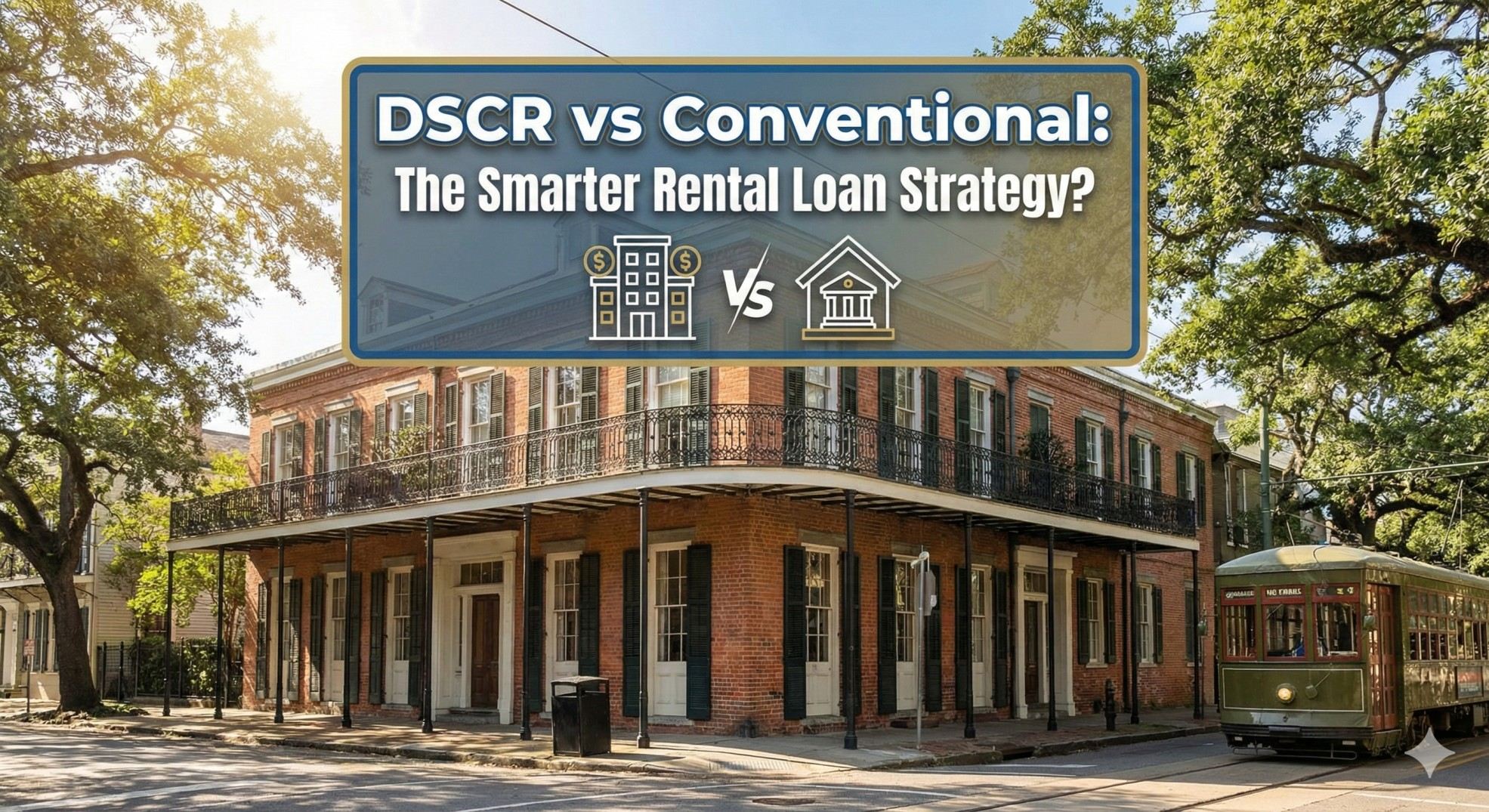
DSCR vs Conventional Investment Loans in New Orleans: Which Strategy Is Right for Long-Term Rental Investors?
If you are investing in long-term rental property in the New Orleans metro area, the loan you choose can either help you scale or quietly limit your growth.
The question I get almost weekly from investors across Jefferson Parish, Orleans Parish, St. Tammany Parish, and St. Bernard Parish is:
Should I use a DSCR loan or a Conventional investment mortgage?
After more than 20 years in the mortgage industry, I can tell you the answer is not about trends. It is about strategy.
Let’s break this down clearly, locally, and practically.
What Is a DSCR Loan?
A DSCR loan qualifies the property based on the rental income it generates rather than your personal income.
If the property cash flows at the required ratio, you may qualify without providing personal tax returns.
This makes DSCR especially attractive for:
Self-employed investors
Investors with heavy write-offs
Portfolio builders
Out-of-state investors buying in Louisiana
What Is a Conventional Investment Loan?
A Conventional investment loan qualifies you based on:
Tax returns
W-2s or business income
Debt-to-income ratio
Credit history
It is more documentation-heavy, but often comes with:
Better interest rates
No prepayment penalty
Potentially lower long-term cost
And this is where many investors make a mistake.
The Most Common Mistake Investors Make
One of the biggest mistakes I see in the New Orleans market is this:
An investor chooses a DSCR loan when they fully qualify for a Conventional loan.
Why does that matter?
Because Conventional financing typically offers:
Lower interest rates
No prepayment penalty
Most DSCR loans include a three-year prepayment penalty to help lower the interest rate. If you plan to refinance or sell within that window, that penalty matters.
The right loan is not about what is easier. It is about what fits your strategy.
Real Example: Scaling with DSCR
I have helped several clients scale using DSCR when Conventional was not an option.
One particular investor purchased two four-unit properties using the DSCR program.
Under Conventional guidelines, the required tax returns and income verification would not have supported approval. The investor had legitimate income but substantial write-offs.
With DSCR, we were able to qualify based on the rental income instead of personal tax documentation.
That flexibility allowed the investor to grow their portfolio faster.
This is where DSCR can be powerful.
Key Differences: DSCR vs Conventional in Louisiana
Income Qualification
DSCR: Property-based qualification
Conventional: Personal income-based qualification
If your tax returns do not reflect your real earning power, DSCR may offer flexibility.
Interest Rate and Cost Structure
Conventional: Typically lower rates, no prepayment penalty
DSCR: Slightly higher rates, often 3-year prepayment penalty
If you qualify for Conventional, it may be the more cost-effective solution long term.
Reserve Requirements
This is the underwriting challenge most Louisiana investors underestimate.
Many DSCR programs require three to six months of reserves.
I frequently see investors who have:
Down payment
Closing costs
But fall short on reserves.
Planning liquidity ahead of time is critical.
Scalability
Conventional loans typically cap financed properties at 10.
DSCR programs often allow greater flexibility for scaling portfolios.
For investors purchasing duplexes, triplexes, or fourplexes in areas like Metairie, Gentilly, Slidell, or Chalmette, this matters.
Local Insight
There is no single parish more favorable for DSCR.
DSCR loans are available throughout:
Jefferson Parish
Orleans Parish
St. Tammany Parish
St. Bernard Parish
Even out-of-state purchases
The determining factor is not the parish. It is the property’s ability to support the required debt service coverage ratio.
What This Means for You in the New Orleans Area
If you are:
A strong W-2 earner with good documentation
Conventional may be your better option.
A self-employed investor with aggressive write-offs
DSCR may allow approval where Conventional cannot.
Short on reserves
You may need to strengthen liquidity before pursuing DSCR.
A first-time homebuyer or limited-asset borrower
DSCR may not be ideal.
In fact, I generally advise avoiding DSCR if:
You are a first-time homebuyer
Your credit score is under 660
You have limited assets
DSCR is a strategic tool, not a beginner loan.
People Also Ask
Do DSCR loans require tax returns in Louisiana?
Generally no. Qualification is based on property income, not personal income documentation.
What credit score is required?
Most programs require scores starting in the mid-600s, with stronger terms for higher scores.
Do DSCR loans have prepayment penalties?
Many do. Commonly three years. Always review terms carefully.
How is the debt service coverage ratio calculated?
Monthly rental income divided by the total monthly housing expense.
Can I buy a fourplex in New Orleans with DSCR?
Yes, as long as it is a long-term rental and meets program guidelines.
Myth-Busting
Myth: DSCR is always better for investors
Not true. If you qualify for Conventional, it often has better pricing and no prepayment penalty.
Myth: DSCR is easier across the board
It may be easier on income documentation, but reserve requirements can be stricter.
Myth: DSCR is only for large investors
Not necessarily. It is about structure, not size.
Action Plan for Rental Investors
Review your tax returns and income documentation.
Evaluate liquidity and reserve capacity.
Compare DSCR vs Conventional scenarios side by side.
Consider long-term portfolio goals.
Structure financing before making offers.
The strategy should match your five-year plan, not just this purchase.
FAQ: Louisiana Investor Financing
Is DSCR available for duplexes and fourplexes?
Yes, most programs allow 1 to 4 units.
Can out-of-state investors use DSCR in Louisiana?
Yes, many programs allow this.
Are reserves required for Conventional loans?
Yes, though often fewer months than DSCR.
Which loan is better for refinancing?
It depends on timing and whether prepayment penalties apply.
Does DSCR work for someone with limited assets?
Usually not ideal due to reserve requirements.
Final Thoughts
DSCR is a powerful tool when used strategically.
Conventional financing is often more cost-effective when you qualify.
The key is understanding which lane you are in before you commit.
If you want to compare real numbers and see which option aligns with your investment goals, let’s walk through it together.
Book a Consultation
Want to understand your real monthly payment before you shop?
Let's walk through insurance, flood risk, taxes, and financing options together.
📅 Schedule here: https://api.leadconnectorhq.com/widget/bookings/pre-qualcalendar
Start Your Application
Ready to begin?
📝 Apply here: https://1446745.my1003app.com/1413036/register
Have questions?
📱 Call us at 504-584-8999.
All loans subject to approval. Equal Housing Opportunity.