DSCR Loans in New Orleans: 2026 Guide To Qualifying On Rental Income, Not W2s
Thinking about buying a rental in New Orleans or the surrounding parishes, but your income is not a perfect fit for a traditional mortgage? Learn how DSCR loans let investors qualify based on rental income, typical credit, down payment, and reserve guidelines, plus real insights from local mortgage advisor Charles H. Parharm, Jr.
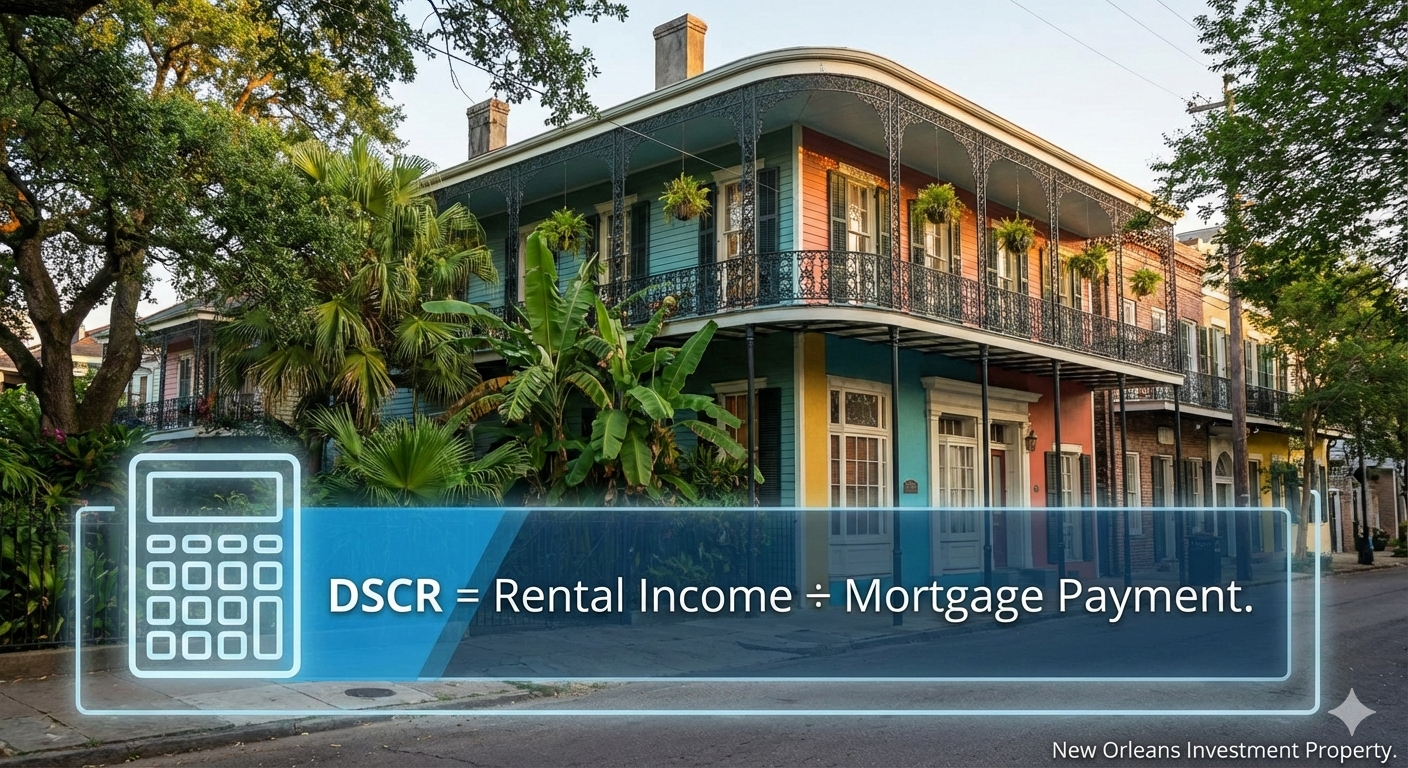
DSCR Loans In New Orleans: Qualifying On Rental Income Instead Of W2s
If you are looking at rental properties in New Orleans or the surrounding parishes, you may have already hit a wall with traditional mortgages. Maybe your tax returns show a lot of write offs, you are self employed, or you already own several properties and your debt to income ratio is not pretty on paper.
That is exactly where a DSCR loan can open doors.
DSCR stands for Debt Service Coverage Ratio. Instead of focusing on your personal income, lenders look at whether the property’s rental income can comfortably cover the mortgage payment. For New Orleans investors, that can be a powerful way to qualify for 1 to 4 unit residential investment properties, including long term rentals and, where allowed, short term rentals like Airbnb.
With more than 20 years in the mortgage and real estate industry, I have seen DSCR loans help investors move forward when traditional financing said no. In fact, I recently helped a client close on a DSCR duplex in New Orleans in less than three weeks with no income verification, no tax returns, no W2s, no pay stubs, and no verification of employment. The property’s cash flow told the story.
What Is A DSCR Loan And How Does It Work?
A DSCR loan is a non QM (non qualified mortgage) designed for investment properties. Instead of qualifying you based on your W2s, tax returns, or a strict debt to income ratio, the lender asks one key question:
Does the property’s rental income support the mortgage payment and other housing costs?
The basic formula looks like this:
DSCR = Gross Monthly Rental Income ÷ Total Monthly Mortgage Payment (PITIA)
PITIA = Principal + Interest + Taxes + Insurance + Association dues (if any).
A DSCR of 1.00 means the rent just covers the payment.
A DSCR of 1.25 means the rent is 25 percent higher than the payment, which many lenders view as strong cash flow.
For New Orleans investors, that DSCR number matters more than how your last two years of tax returns look.
Typical DSCR Loan Features For Residential 1 to 4 Unit Properties
Exact rules vary by lender, but many DSCR programs for Louisiana offer:
Eligible properties: 1 to 4 unit residential investment properties
Occupancy: Investment only, not primary residence
Qualifying income: Actual leases or market rent from appraisal
Documentation: No personal income documentation required in many programs, which means less paperwork and more focus on the property itself
I will always walk through the current DSCR options and guidelines with you, since every lender and scenario is a little different.
Why DSCR Loans Fit The New Orleans Area So Well
The New Orleans metro and nearby parishes have a unique mix of:
Strong tourism driven demand in parts of Orleans Parish and pockets of Jefferson and St. Bernard
Steady long term rental demand in suburbs like Metairie, Kenner, and across St. Tammany Parish
Rising insurance costs and property tax differences parish to parish that directly affect cash flow
Investors are attracted to:
Historic shotguns, duplexes, and fourplexes that work well as rentals
Neighborhoods with strong long term tenant demand near job centers, schools, and hospitals
Legal and properly permitted short term rentals in tourist friendly pockets
Because DSCR loans look at the relationship between the rent and the total payment, they naturally force you to consider the full New Orleans picture: taxes, hazard and flood insurance, and HOA dues, not just the purchase price.
Local Insight
In the New Orleans area, insurance and flood costs can make or break a DSCR deal. Two properties with the same purchase price but different flood zones can have very different DSCR outcomes once you factor in premiums. One of my recent DSCR clients on a New Orleans duplex saw this first hand. The numbers only worked because we paired the right DSCR program with a smart insurance strategy and realistic rental projections.
Although this article focuses on New Orleans and surrounding parishes, DSCR loans can be a strong tool anywhere in the country because of their relaxed proof of income requirements. The idea of qualifying on cash flow instead of traditional income documentation is naturally attractive for investors in many markets.
Key DSCR Guidelines Investors Ask About Most
What Credit Score Do You Need For A DSCR Loan?
Many DSCR programs in Louisiana will consider borrowers starting around the mid 600s, but a 700 or higher credit score is typically where the most flexible guidelines and better pricing start to show up.
In practical terms:
Around 700 and above
More competitive interest rates
More flexibility on DSCR and reserves
Often better options for short term rental strategies
Below 700
Expect possible higher down payment requirements
Some lenders may require stronger DSCR, additional reserves, or more conservative terms
In certain cases, you might see extra conditions such as an additional appraisal or tighter property guidelines
From what I see every day, having a 700 plus credit score can play a vital role in qualifying for a DSCR loan with the most lenient underwriting guidelines.
How Much Down Payment Is Typical On A DSCR Loan?
For many Louisiana DSCR programs:
Twenty percent down is a common starting point for solid borrowers and strong properties
Lower credit or weaker DSCR ratios can push that higher, sometimes to 25 percent or more
Your exact down payment will depend on:
Credit score
Property type and condition
DSCR level
Use case, such as long term rental versus short term rental
How Many Months Of Reserves Do Lenders Want?
DSCR lenders usually want to see money in the bank after closing, often referred to as reserves. Typical ranges are:
Three to six months of reserves on the subject property’s payment
Sometimes additional reserves if you own multiple financed properties
Reserves can often be met using checking, savings, money market accounts, or sometimes retirement funds, subject to program rules.
As a rule of thumb, I always tell first time investors to keep as much in reserves as possible. You want to be prepared for the unknown. In real life, the most common unknown is an unexpected repair that hits at the wrong time. Strong reserves protect both your stress level and your long term investing plan.
What DSCR Ratio Do Investors Need?
Many DSCR investors aim for a ratio around 1.20 to 1.25 or higher. That means:
If your total payment is 2,000 per month, lenders like to see rent of about 2,400 to 2,500 or more
Some programs allow lower DSCR, even below 1.0, at higher rates or with bigger down payments, but that is advanced territory and must be evaluated carefully for risk.
What This Means For You In The New Orleans Area
If you are an investor in Orleans, Jefferson, St. Tammany, St. Bernard, or nearby parishes, DSCR guidelines translate into very practical questions:
Does the projected rent really support the payment once you factor in:
Parish property taxes
Homeowners insurance
Flood insurance if required
HOA or condo dues
Is your credit score positioned at or above 700 so you can access better DSCR options?
Do you have 20 percent down and strong reserve funds, or do we need to build a plan to get there?
For example, consider a duplex in Metairie:
Total monthly PITIA: 2,200
Combined monthly rent for both units: 2,800
In this case, DSCR is 2,800 divided by 2,200, which equals 1.27. That is often considered a strong ratio and may support better pricing, assuming credit and other factors line up.
Common DSCR Questions From New Orleans Investors
Can I Use A DSCR Loan For Short Term Rentals In New Orleans?
Many DSCR lenders will allow properties that are operated as short term rentals, using either lease agreements or documented market rent data for underwriting.
However, two things are critical:
Local rules: New Orleans has specific regulations and permitting requirements for short term rentals that can change over time. You must understand and follow city and parish rules.
Underwriting reality: Even if a property can produce high nightly rates, the lender may still lean on conservative rent figures in the appraisal.
I can help you think through both the financing and the risk side so the numbers make sense for your situation.
How Is A DSCR Loan Different From A Conventional Investment Loan?
A quick comparison:
Conventional investment loan
Qualifies based on your full personal income profile and debt to income ratio
Often requires more documentation and can limit how many financed properties you can have
DSCR loan
Qualifies primarily based on property cash flow
Does not require standard income documentation
Designed for investors who want to scale and may already own several rentals
For many New Orleans investors, DSCR becomes attractive once they own a few properties or have self employed income that does not show cleanly on tax returns.
What Are The Pros And Cons Of DSCR Loans?
Pros
Qualify based on rental income
No tax returns or W2s in many programs
Often more flexible on number of properties
Can work well for LLC ownership
Cons
Typically higher interest rates than the very best conventional scenarios
Larger down payment required in many cases
Prepayment penalties are common in investor programs
Only for investment properties, not your primary home
One of the biggest hurdles I help investors overcome is understanding that DSCR is a higher risk loan for the lender. Because of that, the interest rate will usually be above traditional market rates. Once investors understand that they are paying a premium for flexibility and speed, they can decide if the benefits are worth it for their strategy.
Myth Busting: DSCR Loans In The New Orleans Market
Myth 1: You must have perfect credit to get a DSCR loan.
Reality: Many programs start in the mid 600s, but a 700 plus score generally unlocks better pricing and more relaxed guidelines. The key is understanding how your credit profile pairs with the property’s DSCR and your available funds.
Myth 2: DSCR loans are only for big commercial buildings.
Reality: The programs we are talking about here focus on residential 1 to 4 unit properties. These are the same types of homes and small multifamily buildings you see throughout New Orleans neighborhoods and nearby parishes.
Myth 3: DSCR loans ignore taxes and insurance.
Reality: DSCR calculations absolutely include property taxes, homeowners insurance, and flood insurance if needed. That is why working with a local advisor who understands parish level differences is so important.
Myth 4: DSCR is only for full time investors.
Reality: Part time investors, self employed professionals, and first time investors who want their first rental can all benefit from DSCR financing if the numbers work.
Myth 5: Once I close, I am stuck with whatever insurance costs do in the future.
Reality: Insurance costs can change. That is exactly why I advise investors to shop insurance carriers each time the policy renews. Staying proactive about insurance is one of the best ways to protect your DSCR, your cash flow, and your long term returns.
Your DSCR Action Plan In The New Orleans Area
Here is a simple, practical path if you are considering a DSCR loan:
Clarify your strategy
Decide if you want long term rentals, short term rentals, or a mix
Choose your target areas, such as specific zip codes in Orleans, Jefferson, St. Tammany, or St. Bernard
Check your credit and savings
Confirm your current credit score
Review how much you have available for a 20 percent down payment
Set a goal for reserves that covers at least several months of payments plus a cushion for repairs
Run a DSCR style cash flow check
Estimate realistic rents based on current market data
Get ballpark numbers for taxes, insurance, and HOA or condo dues
Make sure the projected DSCR is in a healthy range
Plan for the unknown
Build additional reserves for surprises such as AC failures, roof repairs, and vacancies
Keep a simple plan for re shopping insurance at each renewal so you are always maximizing savings
Talk with a local DSCR focused mortgage advisor
Have me review your numbers, your credit, and your goals
Discuss which DSCR programs fit your situation and timeline
Align with a knowledgeable local real estate agent
Work with an agent who understands DSCR investor needs and local rules, especially if short term rentals are part of your strategy
Lock in financing and execute your plan
Once you are comfortable with the DSCR, payment, reserves, and potential insurance paths, you can move forward and make offers with confidence.
DSCR Loans In New Orleans: FAQ
1. Can I use a DSCR loan to buy a duplex or fourplex in Jefferson or St. Tammany Parish?
Yes. Most DSCR programs are built around 1 to 4 unit residential investment properties, including duplexes, triplexes, and fourplexes. Parish location, condition, and rental demand still matter, but these properties are a natural fit.
2. Do DSCR lenders care if the property is in a flood zone?
Yes. Flood zones can impact insurance costs, which flow directly into the DSCR calculation. A property in a higher risk flood zone may still qualify, but you must be comfortable with the total payment and the resulting DSCR.
3. Can I use projected Airbnb income to qualify?
Some lenders will work with documented short term rental projections or market rent data, but they may apply conservative assumptions. You also need to make sure the property is permitted and compliant with New Orleans or parish level short term rental rules.
4. Can I close a DSCR loan in an LLC name?
Many DSCR investors choose to hold properties in LLCs. Program rules vary, so it is important to review title and borrowing structure with your lender and your legal or tax advisors.
5. Is there a limit on how many DSCR loans I can have?
Most DSCR platforms are designed for investors who want to scale. There are limits and risk guidelines, but they are usually more flexible than conventional loan caps. Your full portfolio and liquidity will be part of that discussion.
6. Are DSCR loans only for experienced investors?
Not necessarily. First time investors can use DSCR financing if they meet the credit, down payment, reserve, and DSCR requirements. The key is education, realistic expectations about rates, and strong planning around reserves and insurance.
7. Do DSCR loans always have prepayment penalties?
Many DSCR investor programs include some form of prepayment penalty. The details vary by lender and product, so you should always have this clearly explained before you lock in a loan. I will cover this with you before you commit.
Soft Next Steps: Talk Through Your DSCR Options
If you are looking at a 1 to 4 unit rental in the New Orleans area and want to know whether a DSCR loan fits your plan, the next step is a simple conversation.
You can walk through:
Your credit profile and savings
Your target neighborhoods and property types
Sample DSCR numbers based on current local taxes and insurance
From there, you will have a much clearer picture of what is realistic and how to structure a smart offer.
Book a Consultation
Want to understand your real monthly payment before you shop?
Let's walk through insurance, flood risk, taxes, and financing options together.
📅 Schedule here: https://api.leadconnectorhq.com/widget/bookings/talk-with-charles
Start Your Application
Ready to begin?
📝 Apply here: https://1446745.my1003app.com/1413036/register
Have questions?
📱 Call us at 504-584-8999.
All loans subject to approval. Equal Housing Opportunity.